Posts

TAI: Inquiry Learning.

Image
Focus Inquiry: I have chosen 3 disengaged boys in my class to focus my inquiry on. My evidence says: These gentlemen choose to do the bare minimum in most projects and do not see the need to learn lots of things we do in school. We are focusing our Inquiries on Science currently and I think this will be a great place for me to start to make change that can filter into my other subjects. All three of these boys really dislike working on things they think are not useful. They all hate talking in videos that are put online. I have asked them how they would like to present their work and they chose powtoon.  I wanted to see if they could make a decent powtoon in a short amount of time so, asked them to begin by just showing me they could do that. They completed a powtoon quite quickly and were eager to show it to me. They have all expressed interest in being able to choose some things we look into. They are all very adept at technology have have given me very detailed and ...
Science PD with Susan Heeps: Meeting/reflection on lesson March 13th

'When we notice things we automatically connect with out prior knowledge'  Susan Heeps, 2017 Observing our environment 1: Lay under tree and look/listen 2: write down anything we saw-no talking- just what is in your head 3: share what you wrote 4: draw a leaf 5: find one that is different in 2/3 ways 6: why is it different? Describe with your group. 7: why do you think it looks like that? what is the purpose of.. leaf shape, structure etc. Follow on:  -leaf rubbings -laminate different leaves and look over time, what is the patter? -leaf detective, (teacher take photos and students find the place where the leaves are, higher grades, 'why do you think that leaf grows there? shape? colour etc) -cut leaf sideways, look at the structure -pummel in mortar and pestle, get colour out with metho. Ice +3 activity  Blue ice cube, yellow ice cube and oil, water, or air. When recording we make a big deal about date because we are collecting data. Exp...

Applying Tataiako

Image
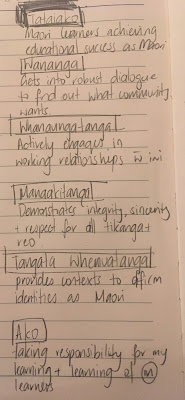
To be culturally responsive is to really get to know Tataiako and Ka Hikitia. I want to know how I can meet the Cultural Competenices and so, in order to meet them, I need to really be able to think about them in the classroom and on my feet. To do this, I need to get stuck into them. I had a quick revision today, brought on by trying to work out which ones applied to my PD that I am doing. The link to Tataiako was very helful, although it will be good when it is updated to align with the new STP. Here is my shortened version of what Tataiako means that I am going to refer to when I am writing my reflections.  I will keep referring to the other doc to as I go to make sure I am getting familiar with it. 

Developing Practice through the Spiral of Inquiry

Image
As part of our teaching as Inquiry, Michelle has put together some great questions and pieces of information. I found lots of this very useful, so will be using a lot of it here now and in the future. This blog will form the basis of many of my Inquiries to come I believe- until these questions and focuses become more natural. Adaptive expertise is all about taking responsibility for further learning in order to better meet the needs of your learners.  It makes sense that these are your most difficult to move in order to better reach all learners.   It must be the way we are.  I would argue I am reflective, but need to be more metacognitive and base my hunches on focused evidence. Thinking more about why I am doing things and how they are helping.  Another idea that really stood out for me was the professional conversation. The next video on professional conversations looks into the structure of these and the resources that are brought to these...

Science PD 2. Observation of Susan Heeps in Room 3

Image
Susan took a lesson in my class, demonstrating an effective Science lesson.  The things I noticed were: -she introduced all knew CONCEPTS by relating them to her life or things students would understand. REALLY using their prior knowledge as the first port of call. Not talking about something and then relating it.  So they already had the building blocks assembled ready to go.  She explained every single new piece of vocab - using the same method of breaking up words that we are doing (yay!). Used the " I notice, I think, I wonder "  model, which will become the "I predict, observe explain.." when it gets more sophisticated. This is also the SC so it becomes how we measure our success everytime. It is also good for students because you can't predict without experience.  -she is messy , which is great. I am very clean- that's my way, but perhaps I put too much emphasis on staying clean sometimes. I have habits from before, but I need to rememb...

Science PD

This year we are focusing on Science through out the curriculum for our school wide PD. We will be having sessions with Susan Heeps. Our first session was an introduction to what we will obviously cover through the year and what STEM learning is. STEM learning is Science, Technology, engineering and Maths. Science consists of the natural and physical, Technology will be the tools used to do the science Engineering is all about the made world Science is more a way of being than a field of study on it's own. It is to be self analytical and constantly aware of your own bias. We use our 5 senses for science and we are observers.  When doing any activity it is a good idea to ask ourselves: what do you notice? SEE, HEAR, SMELL, TASTE??, FEEL Finding vocab is useful and should be the focus of the exercise- not just for writing.  This is science vocab that can be recorded. ACTIVITY 1: ICE ICE BABY The Ice challenge was fun, and it generated lots of vocab because i...

ESOL Oral Language Activity

Working with Aldia, who is currently studying the ELL course outside school, has been beneficial in terms of ideas to implement in class for our EL learners but without an observation it is obviously hard to fully understand what has been explained. There are a few strategies and 'games' that she has discussed with us. One being the 'Say it' game. She came and taught the lesson in my class. Step 1: Introduce the vocab. She did this by discussing it as a group (though it would be much better introducing it in context before the lesson if possible.  After the explanation she went on to let the students as each other: Name, I want you to answer A2. Then read the square.  Then they answer, very simple.  And the 'answerer' chooses the next person and the square. What I learned from this.  Alida's explanation was very simple. Not too many words, very clear. The students found it very easy to follow because of this. She explained to me also when pla...