Posts

Showing posts with the label T3

Rumaki Action Plan

Rumaki = Immersion The plan for Park Estate School: TEACHERS Beginning in a week, have rumaki for the fist 5 mins of morning tea everyday.  (starting with baby steps).  For those 5 mins we will have to try and ONLY use te reo. That means if we can't say it- we need to try and work out how. GOAL: To have everyone using some te reo in conversation during kai te wa at P.E.S.  Giving it a go being the focus. Not fluent or perfect, but to remove the fear of trying. REWARDS: There will be biscuits available during rumaki time in the staffroom. Once rumaki is over, the biscuits disappear- hopefully this will entice some attendance- f we need to extend it to 10 mins, great. RESOURCES :  I have already made some labels/ sentences I know we will be needing to start with, then soon we can add/change them as we get better.  I will also bring in the phrase book. BUY IN: Hopefully the staff at P.E.S value the identity and language of our Maori tamariki enoug...

Revitilisation of Te reo- Kura Whakarauora- Notes and lessons

It takes 1 generation to lose a language and 3 to get it back. The secret to revitalisation is intergenerational language use.  (As a school teacher, what is my role in this step?- to assist the students to be more comfortable to use and learn it- they might be generation number 1?) MY JOURNEY- Focus on yourself and build from there. Support system: teachers and students at school. 25 year goal: have my students confidently speaking bilingually. TE REO MEANS TO ME- future of the students identity marker toanga identity revival UNESCO standards for judging a languages level of use: all of them come out as close to extinction. The language will never be 'lost' because it is written down- but it will be extinct soon if we can't get more than 2% of Nz using it. Just Korero More, just use what we have: DO NOT WORRY ABOUT PARTICLES OR SCREWING UP- Just give it a go. 5 Key elements of Language Planning: 1:Value --> give it Mana, what is your group in to? How...

Whose knowledge is important?

Image
What is happening? I am trying very hard to make kaupapa and Māori knowledge important in my classroom. I incorporate a whakatauki in our learning to integrate into our reading program and to underpin our class culture. We use kupu, nga tau, and the students and I try hard to weave both reo and kaupapa into our teaching and learning. Part of this though is thinking about whose knowledge is important, and thinking of my students as cultural beings. Not just as Māori, but as members of our community. Dr Anne Milne, asks, is their cultural identity embedded into every aspect of the school day, no matter the subject, etc? It needs to be "modelled by those in leadership roles". In my class I am in a leadership role, and I am trying to embed cultural identity into everything.  But I am on the outside. I want to use more opportunities to find out and learn. There is one incredibly obvious step I can take, although it could be perhaps seen as a 'token' effort. I need to...

Toolkit with Wiremu

Start with the topic- then add Te Reo, Work out what you are doing, work out the words and then move on from there. You just need the topic and then the level, how do you intergrate into the topics you are doing. topic brainstorm- translate level 3- incorporate the holistic view of everything.  and continue to tranlsate... where is the stroy told by, Maori perspective is important so that the kids know why some scientific ideas match and don't match up. Make it Multi modal for them, just now if Te Reo. Do it with Te Reo. Do a form and quiz them, form it, add a gif. :) We have a pepeha that is gifted from Ta Mahao ho Where is our Haka? Can we keep learning it. We are allowed to add to our Haka and to keep learning it.  They can own it. Know the structure of the whaikorero so that they know where you are from not just by the words, but also by the idiosyncracies. ko Pukeokiwiriki o te awa te manukanuka.

Applying Tataiako

Image
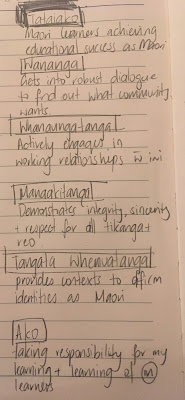
To be culturally responsive is to really get to know Tataiako and Ka Hikitia. I want to know how I can meet the Cultural Competenices and so, in order to meet them, I need to really be able to think about them in the classroom and on my feet. To do this, I need to get stuck into them. I had a quick revision today, brought on by trying to work out which ones applied to my PD that I am doing. The link to Tataiako was very helful, although it will be good when it is updated to align with the new STP. Here is my shortened version of what Tataiako means that I am going to refer to when I am writing my reflections.  I will keep referring to the other doc to as I go to make sure I am getting familiar with it. 

Kia Kaha and Restorative Justice

Image
What exactly is it I want to celebrate? This term we have been focusing on Kia Kaha as a way to create a more positive school culture and to extinguish any power imbalances that exist between the students.  Prior to the programme we had a discussion about the importance of community in the Maori culture and how whakapapa is at the forefront of Maori life, as well as hauora as a model of well being. This was just done as a surface idea and quite briefly. But I am trying to be more culturally responsive and use the little I do know to peak interest in the students.    As part of this program we have been looking into the outcomes of bullying and the emotions/ harm that can come to those being victimised.  In doing so I have become more aware of their emotions and their ability to articulate their feelings. Because of this when dealing with a fight I have begun using restorative justice properly.   What specifically about this achievement is it th...

Inquiry Learning, Lending a Hand and Saving the Planet.

Image
As part of our Learning as Inquiry topic Sustainability,  The students looked into what action they could take as part of our community to help be more sustainable. Their 2 main ideas were, plant some trees and help by growing more plants/ food. The students wrote to our principal and asked for permission to go on a field trip and also if she could help with some materials. Luckily, I heard there was a planting day coming up on the weekend. With this is mind, I contacted Sustainable Coastlines and arranged the for them to go and plant some trees in Drury, close to a new subdivision where the water-ways will suffer.  We made it on a Friday though so that they could attend in school time. This was such a successful day. We planted in excess of 200 trees and the kids were all so happy and into it. It was a really encouraging thing to see, especially after a few morning comments of how 'dumb' this was going to be. :) Matrix was keen to go back and do more on t...

Google Apps For Education

Image
This year I got to go to a google Apps for education summit. I learned quite a few things. A large portion of it wasn't new too, which I think just helped me to actually remember the things I did need to learn. Here is what I learned at the Summit:   HOT TIP: all pics are linked. DAY 1: Introductory chat Am I really giving my students opportunities to meet the Key Competencies? Are they receiving the tools and the explicit skills they need to learn them? Use design thinking to help them see where to go. Have I equipped my students to talk to each other? After the summit, I went back to school and decided that we don't need to put up our hands anymore. When in real life does that happen? So we have started the discussion technique 'Can I add to that?' Helping to equip my kids for the REAL WORLD. A-Z of lesser known Googley Tools This was epic the ones I love are, obvio...